Updated 2025-12-29
1. 2025-July-11: Total/dual correlation/coherence, redundancy/synergy, complexity, and O-information for real and complex valued multivariate data
®Roberto
D. Pascual-Marqui, Kieko Kochi, Toshihiko Kinoshita
®arXiv:2507.08773; https://doi.org/10.48550/arXiv.2507.08773
1.A. Abstract
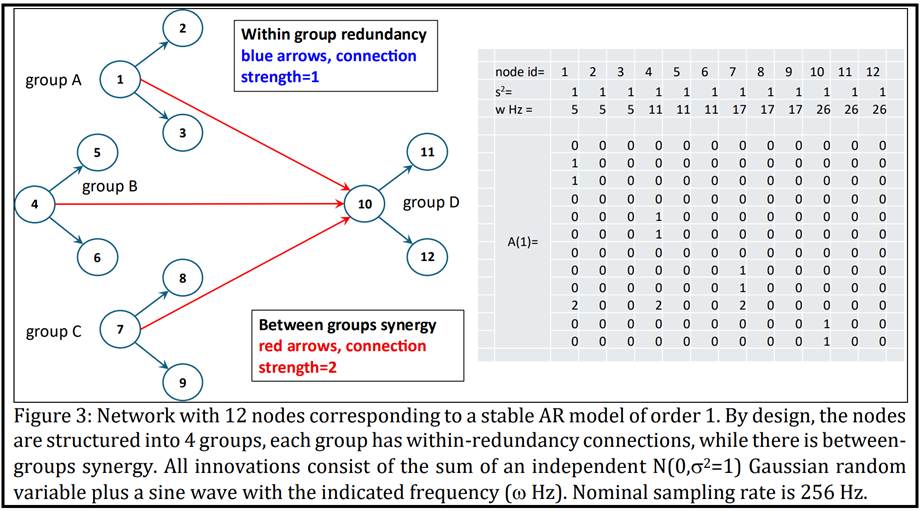
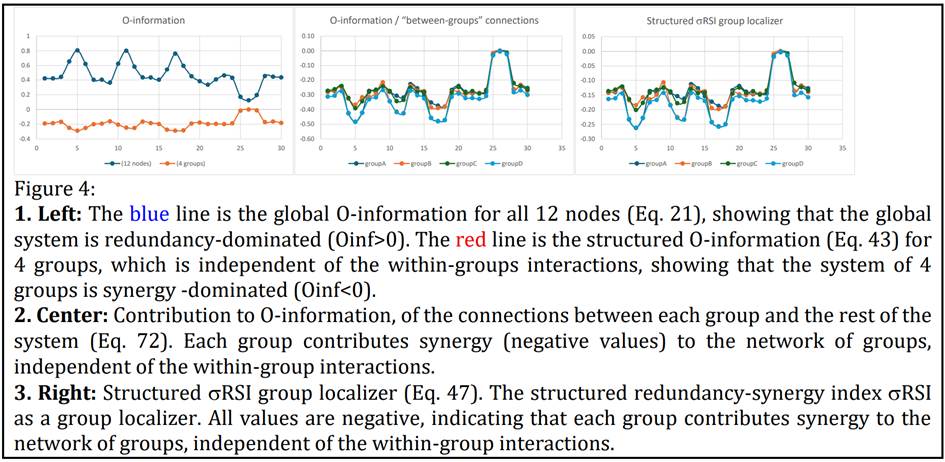
Firstly, assuming Gaussianity, equations for the following information theory measures are presented: total correlation/coherence (TC), dual total correlation/coherence (DTC), O-information, TSE complexity, and redundancy-synergy index (RSI). Since these measures are functions of the covariance matrix "S" and its inverse "S^-1", the associated Wishart and inverse-Wishart distributions are of note. DTC is shown to be the Kullback-Leibler (KL) divergence for the inverseWishart pair "(S^-1)" and its diagonal matrix "D=diag(S^-1)", shedding light on its interpretation as a measure of "total partial correlation", -lndetP, with test hypothesis H0: P=I, where "P" is the standardized inverse covariance (i.e. P=(D^-1/2)(S^-1)(D^-1/2). The second aim of this paper introduces a generalization of all these measures for structured groups of variables. For instance, consider three or more groups, each consisting of three or more variables, with predominant redundancy within each group, but with synergistic interactions between groups. O-information will miss the between group synergy (since redundancy occurs more often in the system). In contrast, the structured O-information measure presented here will correctly report predominant synergy between groups. This is a relevant generalization towards structured multivariate information measures. A third aim is the presentation of a framework for quantifying the contribution of "connections" between variables, to the system's TC, DTC, O-information, and TSE complexity. A fourth aim is to present a generalization of the redundancy-synergy index for quantifying the contribution of a group of variables to the system's redundancy-synergy balance. Finally, it is shown that the expressions derived here directly apply to data from several other elliptical distributions. All program codes, data files, and executables are available (https://osf.io/jd37g/).
2. 2025-April: Alpha rhythm and Alzheimer’s disease: Has Hans Berger’s dream come true?
®Babiloni et al (2025) Clinical Neurophysiology, 172, 33–50.
https://doi.org/10.1016/j.clinph.2025.02.256
2.A. Abstract
In this “centenary” paper, an expert panel revisited Hans Berger’s groundbreaking discovery of human restingstate electroencephalographic (rsEEG) alpha rhythms (8–12 Hz) in 1924, his foresight of substantial clinical applications in patients with “senile dementia,” and new developments in the field, focusing on Alzheimer’s disease (AD), the most prevalent cause of dementia in pathological aging.
Clinical guidelines issued in 2024 by the US National Institute on Aging-Alzheimer’s Association (NIA-AA) and the European Neuroscience Societies did not endorse routine use of rsEEG biomarkers in the clinical workup of older adults with cognitive impairment. Nevertheless, the expert panel highlighted decades of research from independent workgroups and different techniques showing consistent evidence that abnormalities in rsEEG delta, theta, and alpha rhythms (< 30 Hz) observed in AD patients correlate with wellestablished AD biomarkers of neuropathology, neurodegeneration, and cognitive decline. We posit that these abnormalities may reflect alterations in oscillatory synchronization within subcortical and cortical circuits, inducing cortical inhibitory-excitatory imbalance (in some cases leading to epileptiform activity) and vigilance dysfunctions (e.g., mental fatigue and drowsiness), which may impact AD patients’ quality of life.
Berger’s vision of using EEG to understand and manage dementia in pathological aging is still actual.
3. 2024-June-24: Distance-based Chatterjee correlation: a new generalized robust measure of directed association for multivariate real and complex-valued data
®Roberto
D. Pascual-Marqui, Kieko Kochi, Toshihiko Kinoshita
®arXiv:2406.16458; https://doi.org/10.48550/arXiv.2406.16458
3.A. Abstract
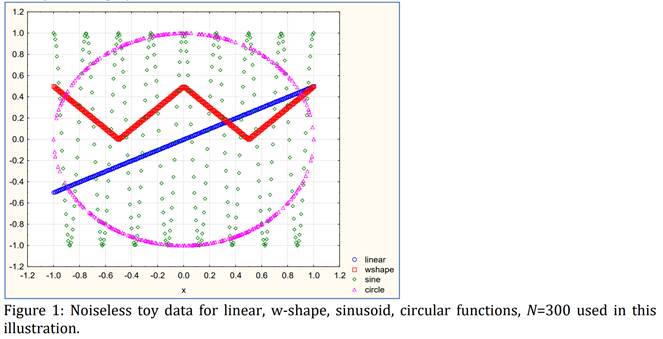
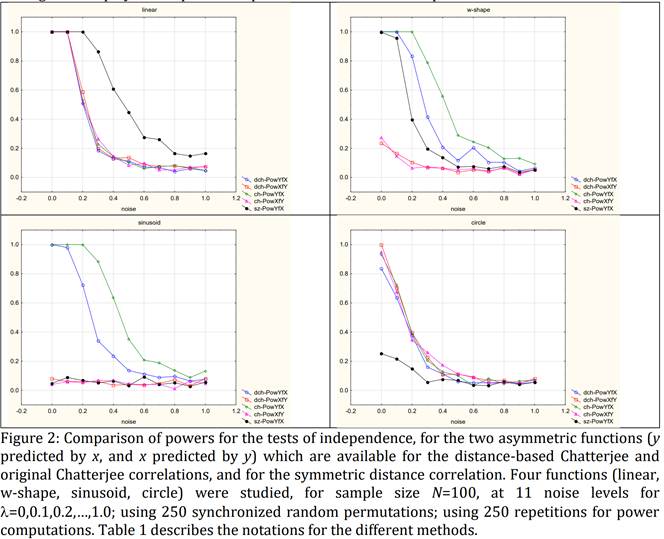
Building upon the Chatterjee correlation (2021: J. Am. Stat. Assoc. 116, p2009) for two real-valued variables, this study introduces a generalized measure of directed association between two vector variables, real or complex-valued, and of possibly different dimensions. The new measure is denoted as the "distance-based Chatterjee correlation", owing to the use here of the "distance transformed data" defined in Szekely et al (2007: Ann. Statist. 35, p2769) for the distance correlation. A main property of the new measure, inherited from the original Chatterjee correlation, is its predictive and asymmetric nature: it measures how well one variable can be predicted by the other, asymmetrically. This allows for inferring the causal direction of the association, by using the method of Blobaum et al (2019: PeerJ Comput. Sci. 1, e169). Since the original Chatterjee correlation is based on ranks, it is not available for complex variables, nor for general multivariate data. The novelty of our work is the extension to multivariate real and complex-valued pairs of vectors, offering a robust measure of directed association in a completely non-parametric setting. Informally, the intuitive assumption used here is that distance correlation is mathematically equivalent to Pearson's correlation when applied to "distance transformed" data. The next logical step is to compute Chatterjee's correlation on the same "distance transformed" data, thereby extending the analysis to multivariate vectors of real and complex valued data. As a bonus, the new measure here is robust to outliers, which is not true for the distance correlation of Szekely et al. Additionally, this approach allows for inference regarding the causal direction of the association between the variables.
4. 2024-June-24: Lagged coherence: explicit and testable definition
®Roberto
D. Pascual-Marqui, Kieko Kochi, Toshihiko Kinoshita
®arXiv:2311.14356; https://doi.org/10.48550/arXiv.2311.14356
4.A. Abstract
Measures of association between cortical regions based on activity signals provide useful information for studying brain functional connectivity. Difficulties occur with signals of electric neuronal activity, where an observed signal is a mixture, i.e. an instantaneous weighted average of the true, unobserved signals from all regions, due to volume conduction and low spatial resolution. This is why measures of lagged association are of interest, since at least theoretically, "lagged association" is of physiological origin. In contrast, the actual physiological instantaneous zero-lag association is masked and confounded by the mixing artifact. A minimum requirement for a measure of lagged association is that it must not tend to zero with an increase of strength of true instantaneous physiological association. Such biased measures cannot tell apart if a change in its value is due to a change in lagged or a change in instantaneous association. An explicit testable definition for frequency domain lagged connectivity between two multivariate time series is proposed. It is endowed with two important properties: it is invariant to non-singular linear transformations of each vector time series separately, and it is invariant to instantaneous association. As a first sanity check: in the case of two univariate time series, the new definition leads back to the bivariate lagged coherence of 2007 (eqs 25 and 26 in https://doi.org/10.48550/arXiv.0706.1776). As a second stronger sanity check: in the case of a univariate and multivariate vector time series, the new measure presented here leads back to the original multivariate lagged coherence of 2007 (eq 31 in https://doi.org/10.48550/arXiv.0711.1455), which again trivially includes the bivariate case.
4.B. Main result:
®Lagged association, excluding instantaneous zero-lag association, IS NOT determined by the imaginary part of the covariance. This is especially incorrect for the multivariate case.
®Lagged association, excluding instantaneous zero-lag association, IS determined by the imaginary part of the regression coefficient matrix. A pure real regression coefficient matrix corresponds to zero lag. Any deviation of the regression coefficient matrix from “pure real” is lagged association.
5. 2023-March-09: EEG resting-state networks in Alzheimer’s disease associated with clinical symptoms
®Aoki
et al: Sci Rep 13, 3964 (2023).
®https://doi.org/10.1038/s41598-023-30075-3
5.A. Abstract
Alzheimer’s disease (AD) is a progressive neuropsychiatric disease affecting many elderly people and is characterized by progressive cognitive impairment of memory, visuospatial, and executive functions. As the elderly population is growing, the number of AD patients is increasing considerably. There is currently growing interest in determining AD’s cognitive dysfunction markers. We used exact low-resolution-brain-electromagnetic-tomography independent-component-analysis (eLORETA-ICA) to assess activities of five electroencephalography resting-state-networks (EEG-RSNs) in 90 drug-free AD patients and 11 drug-free patients with mild-cognitive-impairment due to AD (ADMCI). Compared to 147 healthy subjects, the AD/ADMCI patients showed significantly decreased activities in the memory network and occipital alpha activity, where the age difference between the AD/ADMCI and healthy groups was corrected by linear regression analysis. Furthermore, the age-corrected EEG-RSN activities showed correlations with cognitive function test scores in AD/ADMCI. In particular, decreased memory network activity showed correlations with worse total cognitive scores for both Mini-Mental-State-Examination (MMSE) and Alzheimer’s Disease-Assessment-Scale-cognitive-component-Japanese version (ADAS-J cog) including worse sub-scores for orientation, registration, repetition, word recognition and ideational praxis. Our results indicate that AD affects specific EEG-RSNs and deteriorated network activity causes symptoms. Overall, eLORETA-ICA is a useful, non-invasive tool for assessing EEG-functional-network activities and provides better understanding of the neurophysiological mechanisms underlying the disease.
6. 2022-December-27: Cortical Xi-Alpha model for resting state electric neuronal activity
®Roberto
D. Pascual-Marqui, Kieko Kochi, Toshihiko Kinoshita
®arXiv:2212.13571; https://doi.org/10.48550/arXiv.2212.13571
6.A. Abstract
The power spectra of awake resting state EEG recordings in humans typically have an Alpha peak at around 10 Hz riding a decreasing background “Xi process”. Normal and pathological variations occur in the form of more than one peak or none at all. The single channel Xi-Alpha model (PascualMarqui et al 1988, https://doi.org/10.3109/00207458808985730) separated these two processes and provided an adequate low-dimensional parametric description of EEG spectra. Currently lacking is a generative whole cortex model for activity spectra and intracortical functional connectivity for each process. Here we introduce the “cortical Xi-Alpha model” for such a purpose. The cross-spectral density matrices are modeled as additive components, where each one consists of a scalar spectrum that multiplies a frequency invariant Hermitian covariance matrix for the cortical functional connectivity structure. This model has very low dimension, and despite its simple “separation of variables” form, it offers a very rich repertoire of diverse spatio-spectral properties, as well as diverse whole cortex functional connectivity patterns. The scalp EEG model conserves the same separation of variables form, allowing simple estimation from scalp to cortex.
Two independent open-access, resting state eyes open and closed EEG data sets (203 participants with 61 electrodes, and 47 participants with 26 electrodes) were used to demonstrate, test, and validate the model. Results summary: - The average dimension of the vectorized cross-spectra lies between two and three for the whole cortex, justifying two processes as an adequate approximation for resting state EEG. - A non-negative matrix factorization analysis of population power spectra sampled at 6239 cortical grey matter voxels with only two components (identified as Xi and Alpha) explains 99% of the variance. - The median value of explained variance was 95% for the “cortical Xi-Alpha model” across all datasets and conditions. - The Alpha process is more strongly located in posterior cortical regions, while the Xi process is more distributed and leans towards frontal regions. - The Xi lagged connectivity matrix for cortical sources is isotropic with interdistance, while Alpha is not. - Laminar recordings suggest that pyramidal neurons in layers 2/3 generate the Xi-process, while pyramidal neurons in layers 5/6 generate the Alpha process.
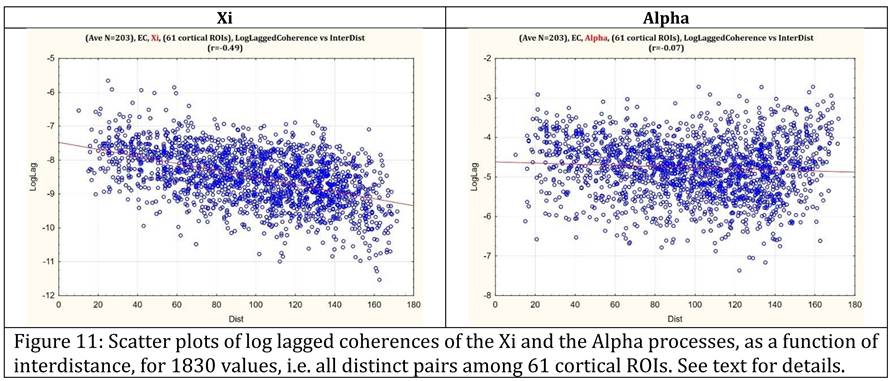
Note: Alpha process connectivity (intracortical, corrected for “leakage” with lagged coherence) is much stronger that the Xi process connectivity (also known as “aperiodic activity”).
7. 2022-2021
Aoki, Y., M. Hata, M. Iwase, R. Ishii, R. D. Pascual-Marqui, T. Yanagisawa, H. Kishima, and M. Ikeda. 2022. “Cortical Electrical Activity Changes in Healthy Aging Using EEG-eLORETA Analysis.” Neuroimage: Reports 2 (4): 100143. https://doi.org/10.1016/j.ynirp.2022.100143.
Pascual-Marqui RD, Kochi K, Kinoshita T. On the relation between EEG microstates and cross-spectra. arXiv preprint arXiv:2208.02540 (2022). https://doi.org/10.48550/arXiv.2208.02540
R. D. Pascual-Marqui, R. J. Biscay, J. Bosch-Bayard, P. Achermann, P. Faber, T. Kinoshita, and K. Kochi, Linear causal filtering: Definition and theory, bioRxiv (2021), https://doi.org/10.1101/2021.05.01.442232.
RD Pascual-Marqui, P Achermann, P Faber, T Kinoshita, K Kochi, K Nishida, M Yoshimura. Pervasive false brain connectivity from electrophysiological signals. 2021-01-28 bioRxiv 428625; doi: https://doi.org/10.1101/2021.01.28.428625