Animal Research in Numbers
In 2025, 53,491 animals were involved in research conducted at UZH, a decrease of 6.2 % compared to the previous year.
In 2025, mice accounted for by far the largest share—just under 80 percent—of the animals used in research at UZH. Other commonly involved animals included rats, house mice, snow mice, pigs, cows, fish, amphibians, dogs, horses, donkeys, and cats. Together with mice, these species accounted for more than 98 percent of all animals involved in research. Birds and chickens, sheep and goats, monkeys, rabbits, alpacas, and ibex were used much less frequently.
Fewer animals than in previous five years
The number of animals involved in research in 2025 dropped by 3,550 compared to the previous year. A total of 53’491 animals were used in the university’s research, training and continuing education. This total is lower than in the years from 2020 to 2023.
Mostly basic research on human diseases
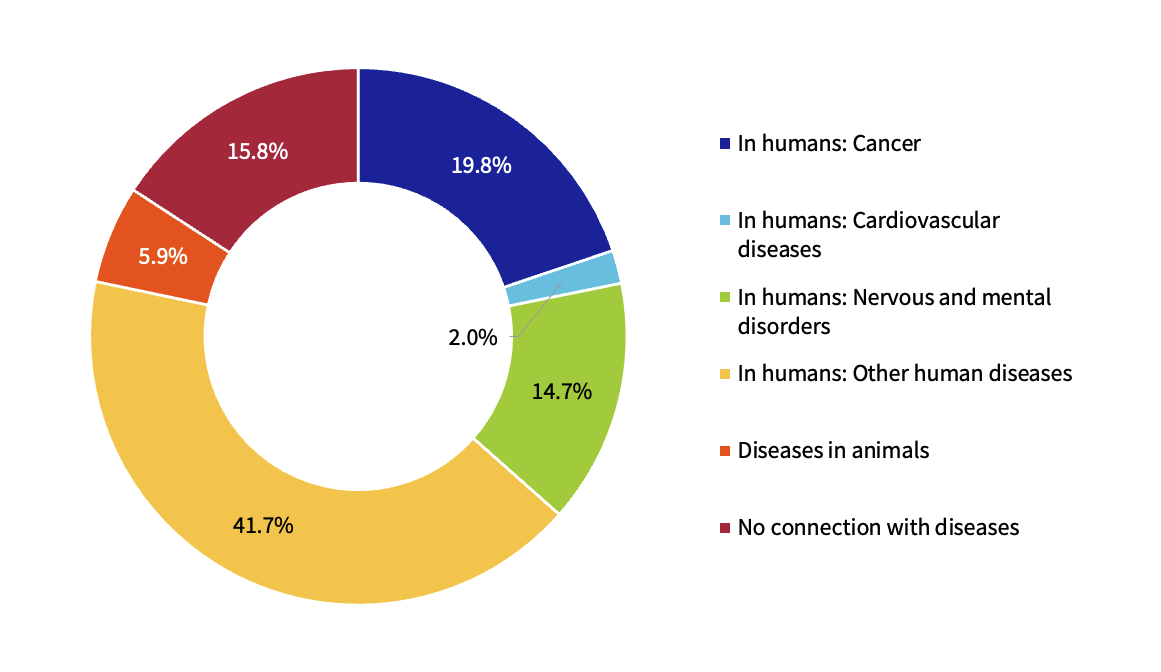
The vast majority of animals (86,1%) was used in basic research, with 78,2% used to study human diseases and 5,9% to investigate animal diseases. This means that 15,8% of animals were not used for research into human/animal diseases, and of these, 3,380, were used in training and continuing education for veterinary students and researchers.
In Switzerland, research involving animals is divided into four degrees of severity (DS) that measure distress or constraint, from 0 to 3 (DS 0, DS 1, DS 2 and DS 3) 20% of the animals used at UZH in 2025 were used in experiments that caused no distress, and 45,2% in experiments that involved little distress. 29,5 % of animals were used in experiments that cause moderate distress, and 5,3% in experiments causing severe distress.
Animals used at UZH in 2025
|
Animal |
Number |
Percentage |
DS 0 |
DS 1 |
DS 2 |
DS 3 |
| Mice (incl. fetuses) | 42,749 |
79.92% |
6,484 |
18,536 |
14,899 |
2,830 |
| Rats (incl. fetuses) | 2,203 |
4.12% |
188 |
1,258 |
748 |
9 |
| House mice, snow voles | 1,995 |
3.73% |
38 |
1,954 |
- |
- |
| Pigs | 1,617 |
3.02% |
1452 |
139 |
17 |
9 |
| Cows | 1,038 |
1.94% |
286 |
746 |
6 |
- |
| Fish (various, incl. larvae) | 995 |
1.86% |
748 |
247 |
- |
- |
| Amphibians (incl. larvae) | 699 |
1.31% |
5 |
694 |
- |
- |
| Dogs | 669 |
1.25% |
542 |
126 |
1 |
- |
|
Horses, donkeys |
510 |
0.95% |
222 |
288 |
- |
- |
|
Cats |
473 |
0.88% |
446 |
27 |
- |
- |
|
Birds, chickens |
237 |
0.44% |
128 |
109 |
- |
- |
|
Sheep (incl. fetuses), goats |
168 |
0.31% |
42 |
31 |
95 |
- |
| Non-human primates (various) |
94 |
0.18% |
94 |
- |
- |
- |
| Rabbits |
20 |
0.04% |
- |
20 |
- |
- |
| Alpacas |
17 |
0.03% |
6 |
11 |
- |
- |
| Ibex | 7 |
0.01% |
- |
7 |
- |
- |
Total |
53,491 |
|
10,681 |
24,193 |
15,766 |
2,815 |
| Percentage |
100% |
|
20% |
45.2% |
29.5% |
5.3% |
DS 0 = Degree of severity 0: No constraint
If an animal experiences no pain, suffering, injury or fear during an experiment, the degree of severity is classed as 0.
These kinds of experiment might involve, for example, observing behavior to research social and cognitive abilities of squirrel monkeys and common marmosets. For larger animals, such as dogs and cows, taking blood samples is included in this category.
20% of the animals used at UZH in 2024 were not subjected to any constraint.
DS 1 = Degree of severity 1: Slight constraint
Degree of severity 1 includes research projects in which the animals experience brief slight pain or injury or slight impairment of their general state of health. If laboratory animals are anesthetized and killed in order to remove tissues or organs from them – e.g. to obtain a cell culture – the degree of severity is also classed as 1.
For example, if an animal is fitted with a permanent catheter in an outer blood vessel or a skin tissue sample is taken, the degree of severity is classed as 1.
In 2025, 45,2% of the animals used in UZH research projects were in this category.
DS 2 = Degree of severity 2: Moderate constraint
If the constraints in an experiment are moderate but brief, or if they are slight but last longer, the degree of severity is classed as 2. Such experiments include repeatedly taking blood samples under short-duration anesthetic or surgical interventions under anesthetic which, despite pain treatment after the operation, cause pain, suffering or impairment of the animal’s general state of health.
At UZH, for example, sheep are sometimes used in studies with degree of severity 2 to research ways to improve healing of tendons, cartilage and bones. Other research, for example, is concerned with developing vaccines against toxoplasmosis – an infectious disease which frequently occurs in cats.
In 2025, a total of 29,5% of animals used in experiments at UZH were in the DS 2 category.
DS 3 = Degree of severity 3: Severe constraint
If the experiments cause the animals severe pain, ongoing suffering, severe fear or severe impairment of their general state of health, or if the constraints are moderate and medium-term or long-term, they are classed as degree of severity 3.
Experiments with the highest degree of severity usually involve mice or rats. They are used to research severe, complex diseases such as cancer, epilepsy, Alzheimer’s, multiple sclerosis and other auto-immune diseases, or organ transplants and infectious diseases.
In 2025, 5.3% of the animals used at UZH were involved in such studies.